Showing posts with label Astronomy. Show all posts

Wednesday, August 29, 2007

Lunar Eclipse

This week Australia experienced a total lunar eclipse, and we had a great view from our deck. Thanks to a tripod, an itchy finger on the shutter button, and some photoshop expertise from Meghan, here's a quick sequence of how the moon looked. From 6:51 pm to 10:24 pm on the 28th, the Earth's shadow swept over the full moon. For an hour and a half in between, no part of the moon received direct sunlight, but the scattered red light from a thousand sunrises and sunsets around the Earth lit it up with an eerie red glow...
Lunar Eclipse
It was astonishing how dramatic and sudden the change was between a black-and-white moon and one lit up in red! We also "discovered" something while watching the eclipse. As you can see, the Earth's shadow enters and leaves the moon at different angles, proving yet again that the Earth is round - or at least, not rectangular!

(Update: These frames were captured on a Canon EOS Digital XT with a Canon 100/f2.8 lens. Exposures ranged from 1/100 sec to 3 sec. With a telescope, you can do much better: for example, see this, and this beautiful sequence.)

Tuesday, May 22, 2007

The Green Bank observatory

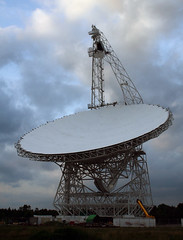
The Green Bank telescope: front view
As you drive out towards Green Bank, in rural West Virginia, cell phone service fades away, and most of the FM dial hisses with empty static. In a world awash with radio noise, the 13,000 square mile National Radio Quiet zone is an oasis of silence. And in its heart sits the Robert C. Byrd Green Bank radio telescope, part of the National Radio Astronomy Observatory. At 100 meters in diameter, the GBT is the world's largest fully-steerable single dish. (It is much larger than the 64 m Parkes telescope, and while the 305 m Arecibo dwarfs them both, Arecibo is not fully steerable.)


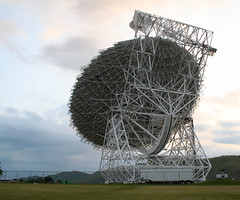
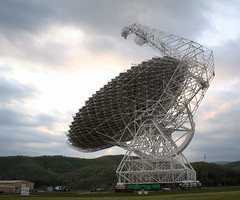
The Green Bank telescope: back view The Green Bank telescope


The massive telescope also has a rather unusual design: it is an off-axis section of a much larger parabolic surface. Its view of the sky is not obstructed by the usual support arms or receivers, leading to wonderful performance characteristics. Each of its two thousand and four surface panels can also be individually adjusted, allowing the telescope to precisely focus radio waves as short as 3 mm in wavelength. However, the unusual design means that each panel is unique, adding cost and complexity, and the telescope is so massive that the track it turns on has repeatedly buckled, leading to shutdowns and expensive repairs. That's what construction by the lowest bidder will do, I guess...

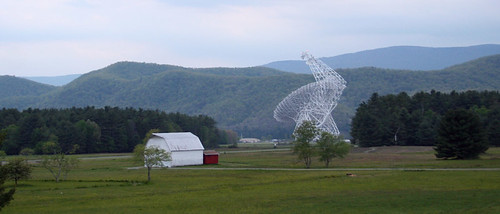
Meanwhile, in spite of the maintenance issues, the Robert C. Byrd telescope (named after West Virgina's powerful senator, like most other large projects in the state) has become one of the most productive radio telescopes in the world. Nestled in the Allegheny mountains, far away from the rest of civilization, it provided a serene backdrop to our pulsar workshop.

The Green Bank telescope

Tuesday, March 27, 2007

Kangaroos at Parkes

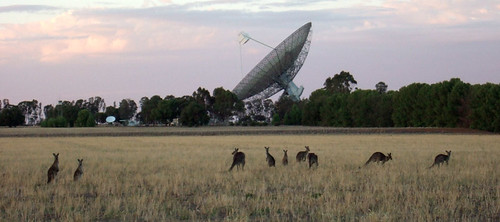
Kangaroos and the dish
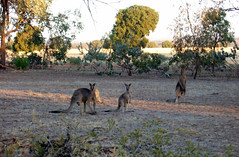
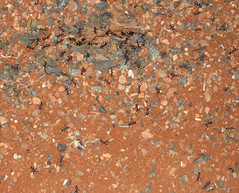
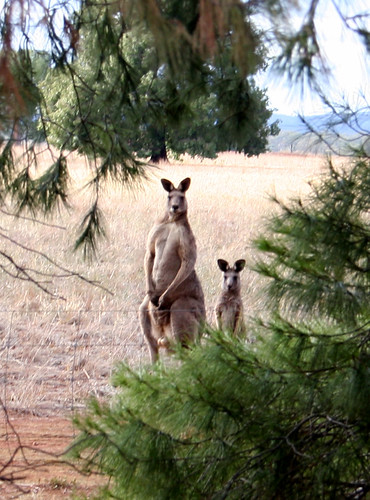
Along with the big dish at Parkes, the other major attraction for us was the kangaroo population. They come out to graze at dawn and dusk, and while I was observing at the telescope, Meghan enjoyed photographing them. In her quest for the perfectly framed shot, she even found herself standing in a nest of ill-tempered biting fire ants, but managed to take her picture anyway!


Kangaroos at Parkes Fire ants!


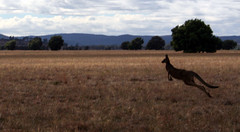
Bounding across the plains
Most of the kangaroos were rather shy, and bounded away gracefully when we stopped to look at them. On the other hand, some of them did not look too pleased to be interrupted in their grazing!


Tough 'roo

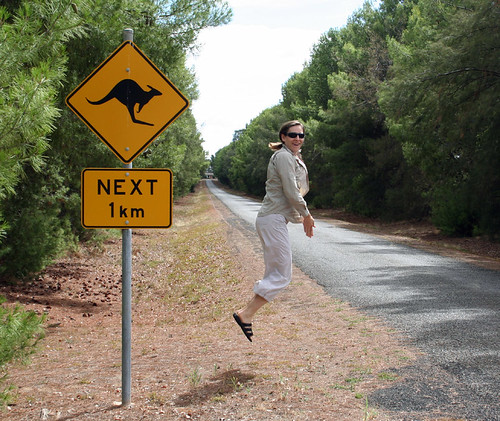
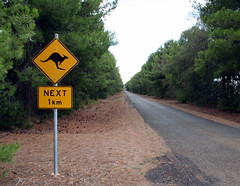
And alas, although I lay in wait by the "Kangaroo Crossing" sign for a long time (see the previous post about Parkes ), I never did catch any 'roos crossing the road. Well, except this one case ...
Kangaroo?

We even managed to capture some video of kangaroos hopping away after we surprised them. If you have enough bandwidth, you can click below and watch them go. (Yes, our very first youtube video, but it is only 8 seconds long.)


Monday, March 26, 2007

Observing at the Parkes radio telescope

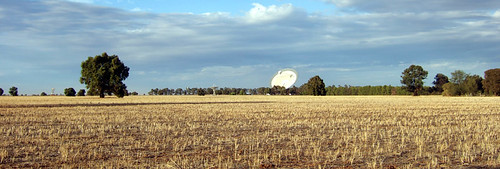
Dish in the distance
Kangaroo crossing
Towards the end of March, Meghan and I drove to Parkes so that I could participate in an observing session. Parkes is a small town about a 6 hour drive from Sydney, deep in central New South Wales, and the Parkes observatory is even further away, in the quiet Australian countryside. As we got close, the dish was visible on the horizon across acres of open farmland, and when we arrived, we were very excited to see the "Kangaroo Crossing" sign on the observatory grounds. (We spent a while waiting next to this sign, hoping for a kangaroo to hop by: more on that later on.)

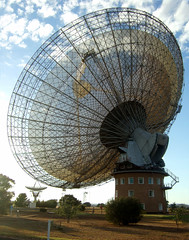
The Parkes radio telescope is huge: 64 meters (or 210 feet) in diameter. It is also fully steerable and has top-notch receivers. With its view of the Southern skies, where the center of our our Galaxy lies, Parkes is one of the most scientifically productive observatories around.


Evening at Parkes Sunrise at Parkes

However, one of the biggest claims to fame for Parkes has little to do with astronomy: when Neil Armstrong first walked on the moon on 21st July 1969, the faint television signal from the lunar surface was received by Parkes and relayed, via Houston, to six hundred million eager viewers around the world. The story of the broadcast is an extraordinary mix of dazzling technical skill, political elbowing, near-disasters and grace under pressure. It was dramatized in the movie, The Dish, which is good fun to watch.
Hard hats required!
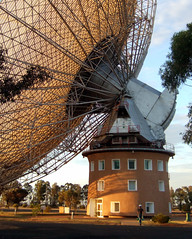
When it isn't receiving pictures of the first man on the moon, Parkes is usually doing astronomical observations. Compared to other observatories I've been to, Parkes is unusual in having no operator, just the astronomer on duty and a big red button that has to be pressed every few minutes to verify that they are still awake! I got a crash course in telescope operation, and then it was straight on to an all-night observing session... Hard hats are required on the concrete apron surrounding the telescope, in case a bolt (or worse) falls off the structure: here's a picture of me bringing a hard hat out to Meghan when she dropped by on her morning run, and another of me in the control room after a long night of observing.
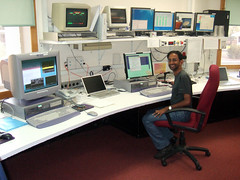
Observing at Parkes The view from the top


The Dish
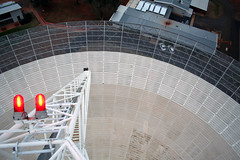
When the dish is stowed, it is possible to climb on to the surface, and even to climb to the focus cabin at the very top, where the receivers are housed. I got a chance to make the climb, complete with safety harness, for a quick receiver check. The view out across the plains was beautiful, and looking down was dizzying! (Notice the cars parked at the office building for scale.)

Next to the telescope, the observatory runs a very nice visitor center, and there is also the Dish cafe. Other than that, it is just the astronomers, and the kangaroos. More on that, coming up next.