Tuesday, March 27, 2007

Kangaroos at Parkes

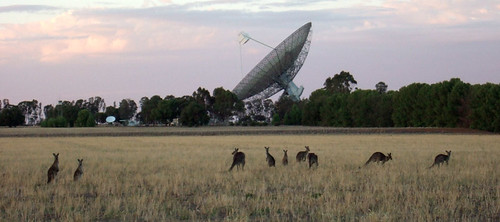
Kangaroos and the dish
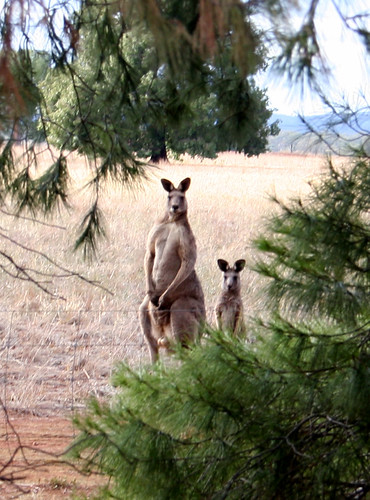
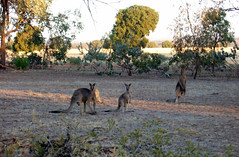
Along with the big dish at Parkes, the other major attraction for us was the kangaroo population. They come out to graze at dawn and dusk, and while I was observing at the telescope, Meghan enjoyed photographing them. In her quest for the perfectly framed shot, she even found herself standing in a nest of ill-tempered biting fire ants, but managed to take her picture anyway!


Kangaroos at Parkes Fire ants!


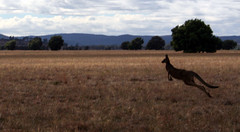
Bounding across the plains
Most of the kangaroos were rather shy, and bounded away gracefully when we stopped to look at them. On the other hand, some of them did not look too pleased to be interrupted in their grazing!


Tough 'roo

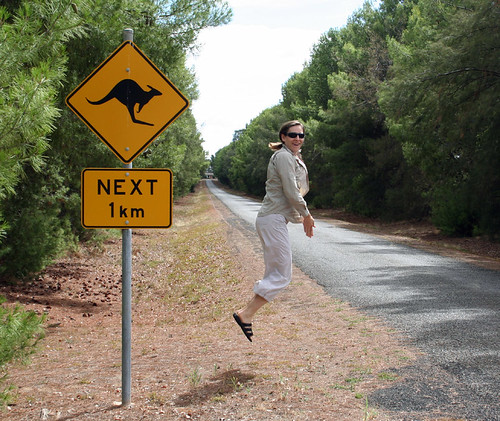
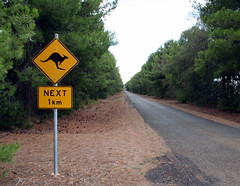
And alas, although I lay in wait by the "Kangaroo Crossing" sign for a long time (see the previous post about Parkes ), I never did catch any 'roos crossing the road. Well, except this one case ...
Kangaroo?

We even managed to capture some video of kangaroos hopping away after we surprised them. If you have enough bandwidth, you can click below and watch them go. (Yes, our very first youtube video, but it is only 8 seconds long.)


Monday, March 26, 2007

Observing at the Parkes radio telescope

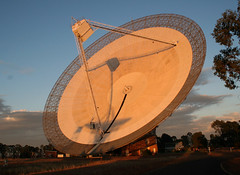
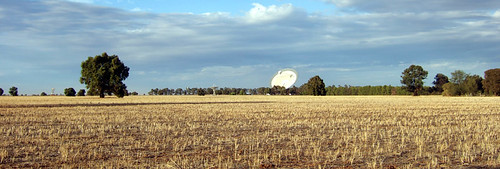
Dish in the distance
Kangaroo crossing
Towards the end of March, Meghan and I drove to Parkes so that I could participate in an observing session. Parkes is a small town about a 6 hour drive from Sydney, deep in central New South Wales, and the Parkes observatory is even further away, in the quiet Australian countryside. As we got close, the dish was visible on the horizon across acres of open farmland, and when we arrived, we were very excited to see the "Kangaroo Crossing" sign on the observatory grounds. (We spent a while waiting next to this sign, hoping for a kangaroo to hop by: more on that later on.)

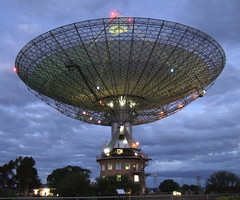
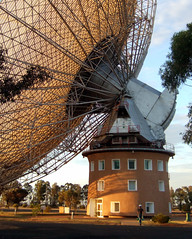
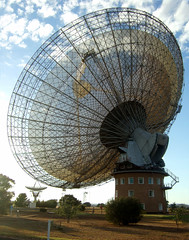
The Parkes radio telescope is huge: 64 meters (or 210 feet) in diameter. It is also fully steerable and has top-notch receivers. With its view of the Southern skies, where the center of our our Galaxy lies, Parkes is one of the most scientifically productive observatories around.


Evening at Parkes Sunrise at Parkes

However, one of the biggest claims to fame for Parkes has little to do with astronomy: when Neil Armstrong first walked on the moon on 21st July 1969, the faint television signal from the lunar surface was received by Parkes and relayed, via Houston, to six hundred million eager viewers around the world. The story of the broadcast is an extraordinary mix of dazzling technical skill, political elbowing, near-disasters and grace under pressure. It was dramatized in the movie, The Dish, which is good fun to watch.
Hard hats required!
When it isn't receiving pictures of the first man on the moon, Parkes is usually doing astronomical observations. Compared to other observatories I've been to, Parkes is unusual in having no operator, just the astronomer on duty and a big red button that has to be pressed every few minutes to verify that they are still awake! I got a crash course in telescope operation, and then it was straight on to an all-night observing session... Hard hats are required on the concrete apron surrounding the telescope, in case a bolt (or worse) falls off the structure: here's a picture of me bringing a hard hat out to Meghan when she dropped by on her morning run, and another of me in the control room after a long night of observing.
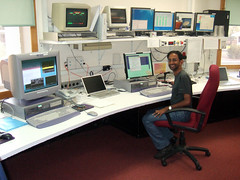
Observing at Parkes The view from the top


The Dish
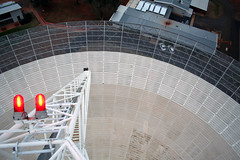
When the dish is stowed, it is possible to climb on to the surface, and even to climb to the focus cabin at the very top, where the receivers are housed. I got a chance to make the climb, complete with safety harness, for a quick receiver check. The view out across the plains was beautiful, and looking down was dizzying! (Notice the cars parked at the office building for scale.)

Next to the telescope, the observatory runs a very nice visitor center, and there is also the Dish cafe. Other than that, it is just the astronomers, and the kangaroos. More on that, coming up next.
Wednesday, February 21, 2007

After the reception

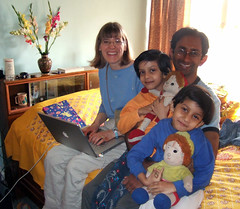
Caitlin, Doyel, Lali, and Shami After the reception things quieted down quite a bit as family and friends returned home. Here is Caitlin sending one last email to her family before leaving for the airport. Shami's nieces (his cousin's little girls) Doyel and Lali, were quite sad to see Caitlin go, and so were we.

Goodbye to Caitlin
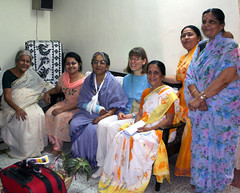
A photo with Caitlin before leaving for the airport: Mashimoni, Chumki, Maini, Caitlin, Lalmashi, Kaki, and Mami (Shami's mother's brother's wife).

You will see that Shami's mother is wearing a cast. Unfortunately she broke her arm the day before the reception! She was in quite a lot of pain, and it was especially hard for her to be immobilized when there was so much to do. But she is incredibly strong and stoic, and handled everything very well.


Opening gifts
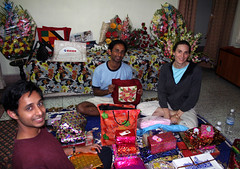
We spent the next evening opening presents. Although the invitation cards requested no gifts, we were nonetheless inundated! We would like to thank everyone for their generosity.

(Shami is holding up a quilted bag that my mother Barbara made, as a gift to Shami's mom. She uses it and loves it! At the reception it was used to collect cards.)


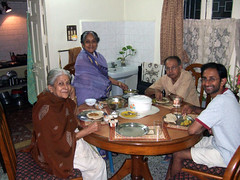
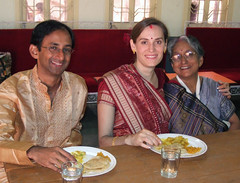
Soon the house was pretty quiet, with just Shami's parents, us, and Mashimoni left. Mashimoni kindly stayed on for a while to help Maini out around the house. Here we are, sitting down to a quiet dinner at home, with dal, a curry and chapatis.

Dinnertime Coconut milk

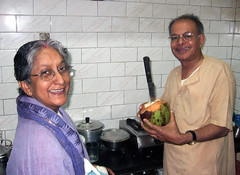
Shami's dad brought home a green coconut so that I could try drinking its sweet milk. Here he is opening it up with a big knife. It was quite good!

Leaving Kolkata
And then, it was time to say goodbye to India and head back to Australia. What an amazing two weeks it had been!

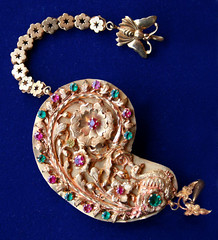
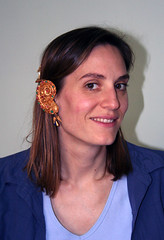
The ornamental ear piece below was one of the gifts I received from Shami's parents -- a real family heirloom. There were two of them, one each for me and Uttara. When she got married, Shami's mother received them from her mother-in-law, who had in turn received them from her mother-in-law. They are incredible pieces, made of solid gold with cut emeralds and rubys. Notice the design of the peacock, with its magnificent tail curling around!


Heirloom earpiece Heirloom earpiece

Saturday, February 17, 2007

The Reception

Walking to the reception
Shami's parents arranged a big reception for the four of us: the newlyweds, Shouri & Uttara, and not-so-newlyweds, me & Shami. It was an all day affair, with family gatherings for breakfast and lunch, and then the big event that evening. Luckily I was able to sneak away with Shami and Caitlin for some much needed rest time in between the events!

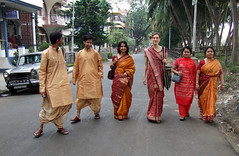
Walking to lunch, photo by Caitlin: Shami, Shouri, Uttara, Meghan, Chumki and Kaki. Kaki helped me out very much by dressing me in all my saris! This silk red sari was given to me by Lalmashi.


Serving payeshServing payesh
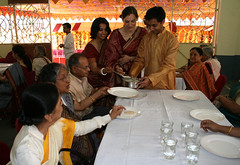
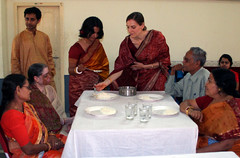
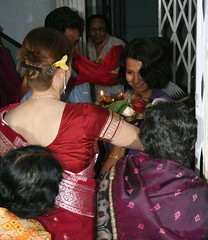
Uttara and I, as the new brides, ceremonially served a sweet rice dish to everyone at the lunch, including Shami's parents (left) and Pishis (right).


Below, at lunch with Shami and Maini.

With MainiMeghan and Caitlin

It was such a wonderful thing that my sister Caitlin was able to travel all the way to India and share all these experiences with me. Her amazing husband Jamie took care of their 4 small kids back in Ithaca for the 10 or so days that she was away. Thanks Jamie! It meant the world to me.

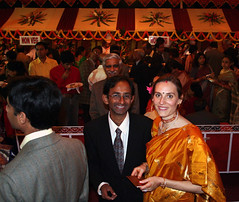
For the evening reception I wore an amazing golden sari, chosen by Shami's father, and all sorts of gold jewelry to go with it. It was truly spectacular, and very much fun to wear.

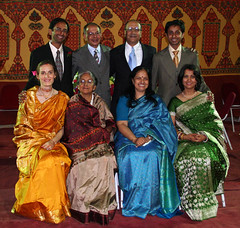
The families
A group photo with Shami's parents, and Uttara's parents.

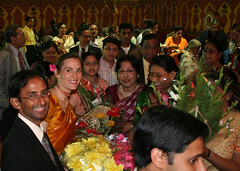
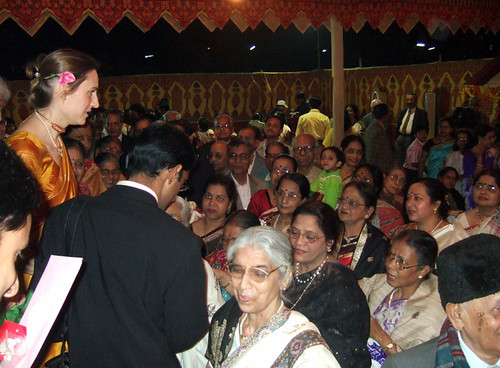
The reception was an incredible affair. About 300-400 guests were expected, and even more than that showed up!

Reception crowdsMore at the recption

There were countless people to meet, but everyone was extremely nice and generous. There were many welcoming words, and gorgeous flowers, and many gifts as well. All the time and effort Shami's parents put into the planning paid off, as it was a wonderful, if exhausting, evening.
Reception crowds

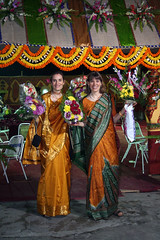
Leaving with flowers
It was very late at night when we finally wound down. Caitlin and I carried home some of the beautiful flowers at the end of the evening.

Friday, February 16, 2007

At Salt Lake

Arrival at Salt Lake
Shami's parents' apartment is in an area called Salt Lake. It evidently used to be a quiet suburb on the edge of Kolkata, but has now become much busier with the sprawl and growth of the city.

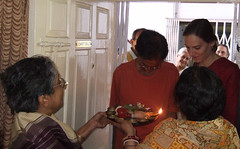
To welcome us, Shami's cousin Chumki had decorated the stairs and landing of the apartment with "alpona," designs painted with rice flour. We were greeted at the door by Shami's mother, aunts and cousins, where they ritually welcomed me to the family home for the first time.

FamilyChumki, Meghan, Kaki
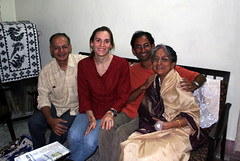
Pictures: Us with Shami's parents, and me with Chumki and her mother (our Kaki, see below). Chumki gave me a pretty silver necklace.


Uttara and Tuku arrive
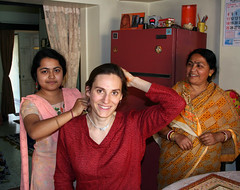
Later that day Kaki helped me get dressed in beautiful red sari that she had given me, along with some lovely silver jewelry from Mashimoni. When Shouri arrived with Uttara, it was my turn to help welcome the new bride to the family home.


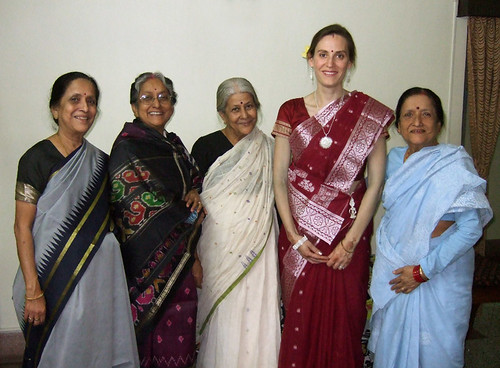
With Shami's mother Sumitra (Maini), and her three sisters. No, I'm not wearing heels!

Four sisters and Bouma
From left to right: Lalmashi, Maini, Mashimoni, Meghan, Bhalomashi.

In Bengali, your mother's sister is your "Mashi". Your father's sister is your "Pishi". Your father's brother's wife is your "Kaki" or your "Jethi", depending on whether it is an older or younger brother... it goes on and on, and can be very confusing to a newcomer!

The train to Kolkata

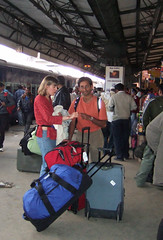
At the train station in New Delhi
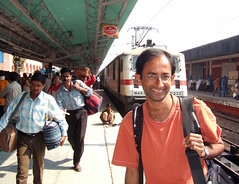
After a great couple of days in Agra and Jaipur, we headed back to Delhi to catch a 4:00 pm train to Kolkata (Calcutta). Our driver negotiated the roads well, but traffic was bad as we came in to Delhi, delaying us quite a bit. We got to the station just on time, and rushed about trying to get to the right platform. The station was noisy, crowded, and the signage was poor. We also had to carry our many bags up and down several long sets of stairs over the tracks. Although we were a bit harried, we made it in just fine.

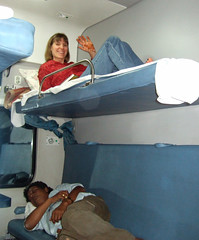
We traveled on the Rajdhani Express, a fast overnight train from Delhi to Kolkata, which takes about 16 hours. We booked tickets for an AC2 car, which meant that the car was air conditioned, and there were only two bunks, stacked, instead of three. This was a luxurious way to travel in India!


Dinner on the train

Bedtime
We were served a snack and dinner, as well as breakfast in the morning. Shami says the food was good, although I had a bit of a hard time with it. After dinner, Caitlin settled in on a top bunk, while my bed was formed by the backs of the two single seats folded down. The bunk was narrow and a bit uneven, but it had a window, which I liked. It was cozy once I pulled the curtains for privacy, and I actually slept fairly well, enjoying the motion and sound of the moving train.

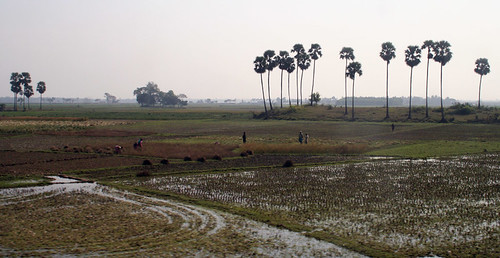
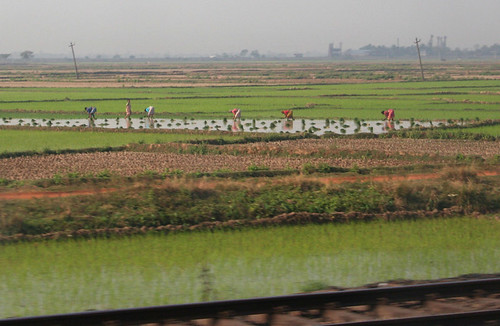
In the morning we again enjoyed looking out the window. The landscape had turned lush and green. It was fascinating to see the villages go by, as well as the many rice paddies. We saw fields in all stages, from the planting to the harvesting, with men, women, children and oxen all doing their part.


View out the windowView out the windowView out the window


Stepping off the train
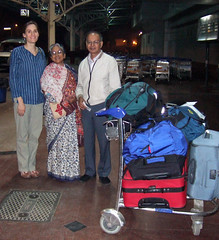
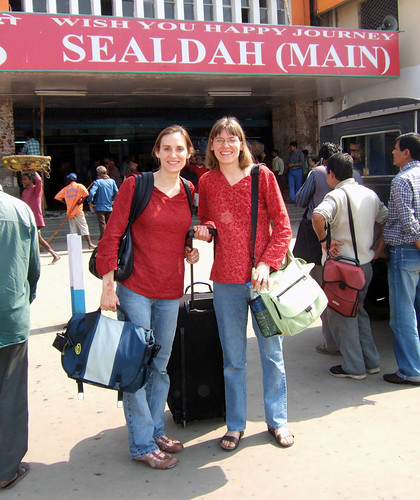
When we finally arrived at Sealdah station, we were graciously met by Shami's cousin Sanjay, and his aunt Lalmashi. They had a car waiting, and soon we were off battling Kolkata traffic on our way to Shami's parents' apartment, where the next chapter of our adventure was about to start!


Leaving Sealdah station

Thursday, February 15, 2007

Jaipur, briefly

Camel on the road
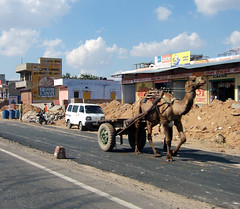
Camels pulling carts were on every street corner as we entered the desert state of Rajasthan, on our way to Jaipur, the next stop on our tour. We had far too little time to spend there, and when we arrived at our hotel in the early afternoon, our guide was waiting to whisk us away to see the sights.


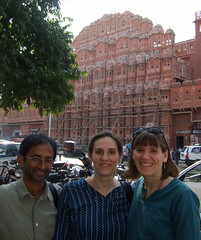
Hawa Mahal
Hawa Mahal, the Palace of Winds, is one of the most iconic images of Jaipur. Part of the City Palace, it has a facade with almost a thousand windows from where the royal women could observe life on the street from behind intricately carved screens.


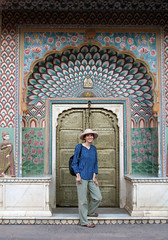
Inside Jaipur's City Palace
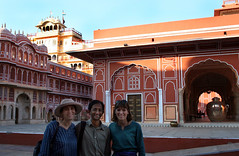
The City Palace is now a museum and gallery, housing collections of royal clothes, art and artifacts from an earlier era. It also has some beautiful architecture, including some gorgeously decorated doors.
Inside Jaipur's City Palace


Notice the silver urn in the picture: Sawai Madho Singh used a set of these massive containers to carry water from the Ganges with him on his voyage to England to attend King Edward VII's coronation in 1902. Each jar is over 5 feet tall, and they are supposedly the most massive silver objects in the world!


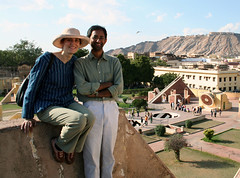
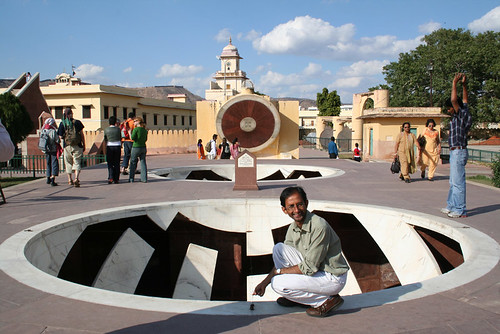
On the King's Sundial at Jantar MantarJantar Mantar was a special treat for us. Maharaja Jai Singh II had this collection of astronomical instruments built in the early 1700s, and it is unparalleled in scale and complexity. The instruments track the stars, predict eclipses, and still tell the local time to an accuracy of seconds!


Jantar Mantar

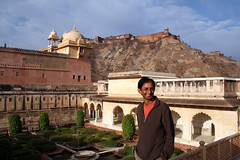
At Amber Fort At Amber Fort


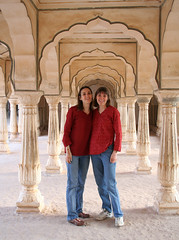
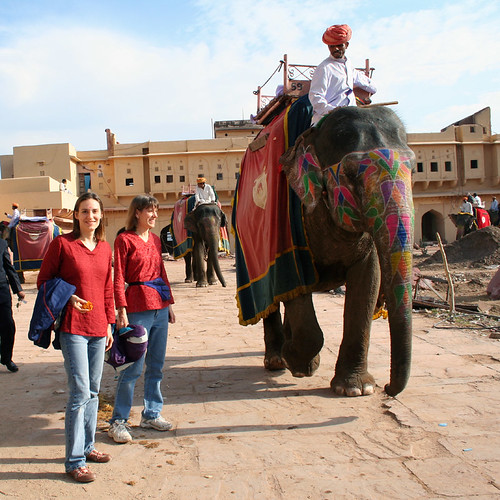
Until the arrival of the British, invading armies traditionally swept into India through the north-west corridor, and the Rajput inhabitants of this region gained a reputation as great warriors. Amber fort was begun by the Rajput ruler Man Singh, whom Emperor Akbar appointed as his general. The fort walls sprawl over the surrounding hills, while inside, there are intricate hallways and corridors, gardens and fountains, halls of mirrors and beautiful views. That morning, we were the first visitors to Amber fort, and as the mist cleared and the sun came out, we were treated to the sight of a long line of elephants bringing tourists up the hillside...
Elephants arriving at Amber Fort